Monday, November 14, 2011

The Supreme Court and Obamacare

I haven't blogged in a long time for several reasons. One reason is that for various purposes, I needed to reduce that amount of political opinion that people read from me. I won't explain why. But the news tonight has caused me to write again.

In some respects, the news that SCOTUS will hear the case about Obamacare isn't surprising at all. Several lower courts have ruled in various ways both for and against and both narrowly and broadly. There's a lot that needs resolved and the lower courts can't do that. Additionally, this has been a controversial issue that gets at the core of the US Constitution. I am a bit surprised though that the case will be heard this March before the 2012 elections.

The defenders of Obamacare could take two approaches: 1. The mandate is a tax and the Constitution in Article 1 gives Congress the right to levy taxes. Besides being having political fallout ("it's not a tax") it violates the Equal Protection clause for similar reasons that the poll tax was found unconstitutional ("We're not taxing blacks, we're just not taxing people who we happen to favor politically.") In other words, the tax isn't based upon what the people do, it's who they are. 2. "The Commerce Clause gives the power to Congress to regulate pretty much anything it wants." You reacted to the previous sentence with dread and horror, or with agreement. If you agreed with that statement, then imagine this: 10 years into the future, the political party you dislike the most has gained control of Congress and the Presidency. Now imagine that every terrible and despicable thing you could imagine you are either forced to buy or to do. Still a good idea? If it isn't 10 years from now, why is it a good idea now?

The other side of this issue is really two ideas: Wickard v. Filburn was decided wrongly and that the 9th and 10th Amendments are in the Constitution for precisely this purpose.

Either way, this decision is going to have a huge impact in the future of America. Either we now continue marching down the avenue of greater and greater government control over our lives without any way to turn back, or we preserve liberty and individual choice a bit longer.

I'll be waiting.

Thursday, December 30, 2010

A More Recent Picture of William

Here's a much more recent picture of William. He's brushing his teeth while riding his car that he got for Christmas.
Posted by Picasa

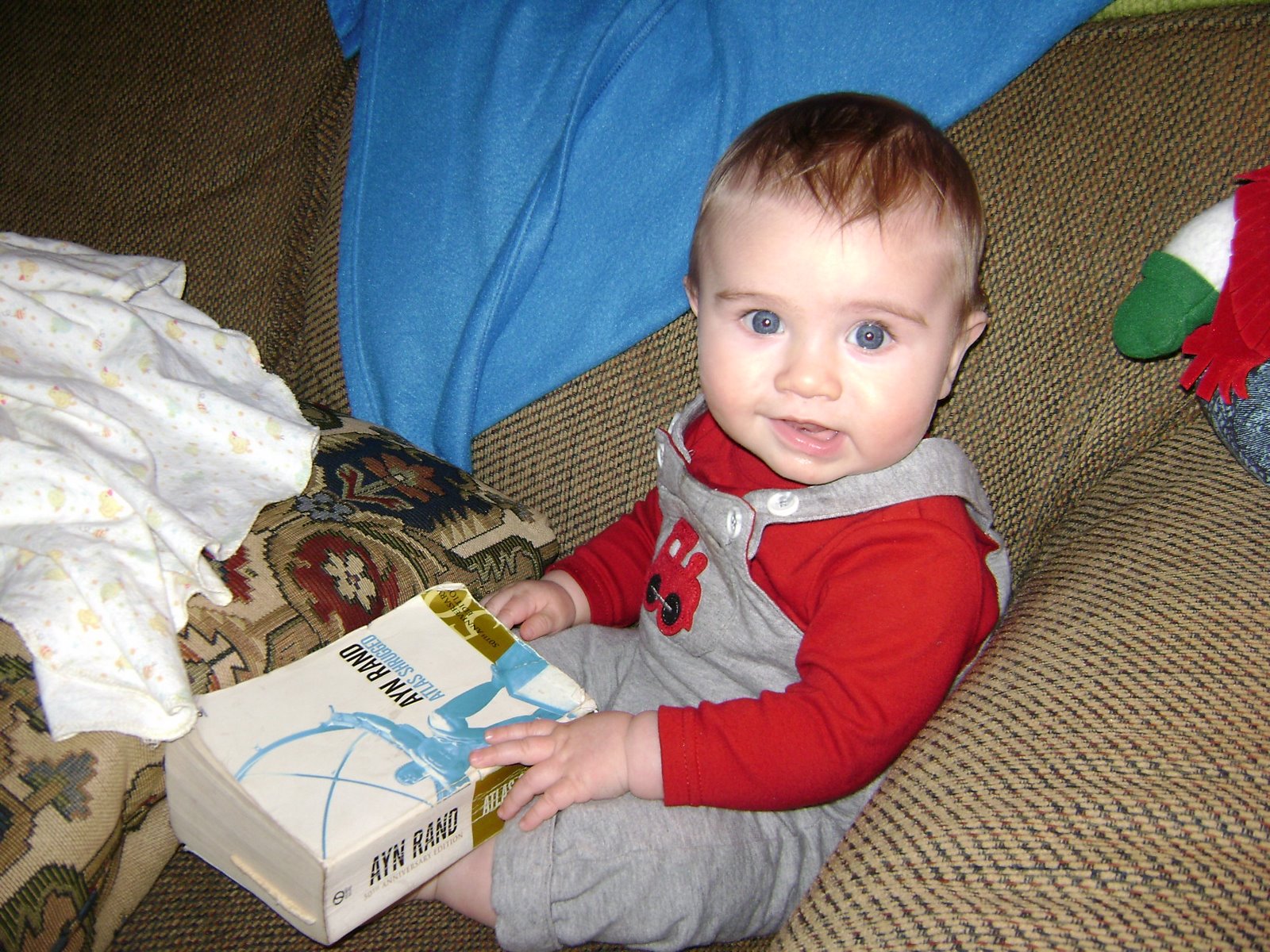
A Good Book

Posted by PicasaThis is a very old picture of William. It's about a year old, but I still think it's great.

Wednesday, September 1, 2010

First Day of School, Earthquake, Related?

Today at about 6:20 we had an earthquake here. I felt it but both the two other members of the household slept right through it.

Later, at 8:30, the first day of school started up. I don't think they're related, but my students might feel otherwise.

Monday, December 7, 2009

CRU Commentary

I've avoided any comments on the Climate Research Unit scandal up until now, primarily because most everything I've thought about it can be read elsewhere so there was no need.

However, I did what to make you aware of a new part of the scandal. Steven Hayward at The Weekly Standard writes:

Under the pressure of Climategate, the CRU has finally agreed to release
its raw data and computer codes. But now we learn that some of the raw data have
been lost, and while Jones should be asked blunt questions about whether he made
good on his threats to delete data, it is possible that the data were lost
through sheer sloppiness. The most devastating document in the CRUtape letters
may be not the egregious emails that have drawn most of the public attention but
the detailed notes of a CRU programmer, Ian "Harry" Harris, assigned the task of
sorting out the handling of the raw data and computer files.

The HARRY_READ_ME.txt file, over 100,000 words long, paints a picture
of haphazard data handling that would get almost any private sector researcher
fired. Among the many damning items included in Harris's narrative are more
instances of "hiding the decline" such as "Specify period over which to compute
the regressions (stop in 1940 to avoid the decline)" and "Apply a VERY
ARTIFICIAL correction for decline!" Worse are Harris's notes of improperly coded
data (or data without codes at all), computer subroutines that don't work, and
near complete chaos: "I am very sorry to report that the rest of the databases
seem to be in nearly as poor a state as Australia was. .  .  . Aarrggghhh! There
truly is no end in sight. .  .  . Am I the first person to attempt to get the
CRU databases in working order?!! .  .  . " On and on goes Harris's catalogue of
software bugs and data horrors. Finally, this: "OH F-- THIS. It's Sunday
evening, I've worked all weekend, and just when I thought it was done I'm
hitting yet another problem that's based on the hopeless state of our databases.
There is no uniform data integrity, it's just a catalogue of issues that
continues to grow as they're found."

No drug company could get through the FDA approval process with data
handling this slapdash, yet the climate policy process contemplates trillions of
dollars in costs to economies around the world based partially on this
incompetent work. Worse, it suggests the possibility that the CRU circle might
not be able to replicate its own findings from scratch, let alone outside
reviewers.


Regardless of what you believe about global warming, you must admit that this is very damaging indeed.

Tuesday, November 24, 2009

Fact-Checking

As I hear more and more about the declining newspaper industry and as I see the declining quality of work from that industry, I'm getting more and more interested in the process of fact-checking in publishing (or lack of it).

I've already blogged about several examples, but I keep seeing the same trend. Here's the latest that I've seen:


You can clearly see that the basic outline of the article and to-do list from a draft copy weren't removed before publishing. This seems like a simple mistake.

In this article in the New Yorker, it seems to indicate every single word is analyzed and anything remotely factual is double-checked. Also, it seems that any mistake made by the fact-checker could have disastrous consequences. It also seems that in the process, simple mistakes like the one above would be corrected.

But I don't see this happening. If I, a reader who has no training in journalism, can spot simple mistakes, why don't the industry's fact-checkers. I decided to find out. I wanted to know the process and the methodology.

Then I discovered why.

Most newspapers don't even have fact-checkers. From a business approach, this doesn't seem like a very good idea. Fact-checking is essentially the quality-control for the paper. In a declining industry, newspapers have decided they would rather print erroneous articles than accurate articles. It seems like they are accelerating their own deaths. Imagine GM deciding that because of their financial problems, they would rather make cars that don't actually work simply to be able to produce more cars. Would this attract buyers? Would it increase their market viability? No. If a car company wouldn't make this decision, why would papers?


It seems like there should be a solution. I don't know what it is.

I do think however that blogging and the blogger community can offer a model. No, I don't think blogging with replace professional journalism, but I think professional journalism can learn from bloggers.

One of the better aspects of the blogger community is that bloggers are constantly reader other blogs, making comments, suggestions, and corrections if necessary. Serious bloggers are then honing their posts. Why can't journalists do this?

Why can't a newspaper, say with 20 journalist, require that each journalist have two others read, comment upon, correct, and fact-check articles? Yes, this would take more time and effort, but all quality-control does. But, in general, quality control is a valuable tool in producing a product. Journalism needs to regain this.

Wednesday, October 7, 2009

William

He's growing up fast. He's ready to roll over, he just hasn't quite figured it all out yet. Also, he's long. Apparently, he's in the 90th percentile for height. I think he got my brother's genes. How does that happen?


Posted by Picasa

FTC Stomps on the 1st Admendment

Your ability to exercise your First Admendment Rights was constricted on Monday. The FTC passed a ruling saying that bloggers must declare anything they receive free from a company. While this might sound good as a method to protect the public from fraud, it is yet another step in seizing your liberty. Before you say, "over-reacting," I want to remind you that the persecution of people by governments in modern history has rarely been done by sudden, sweeping declaration; rather incremental and apparently reasonable restrictions are erected one-by-one until a cage is constructed. We must be diligent!

Beside, restricted free speech isn't free. Free means without bounds. I may may not like what someone has to say, but I do support their right to say it. Apparently, the FTC doesn't agree.

What? Am I still over-reacting? Go read it for yourself. The ruling is vague and will only be enforced on a "case-by-case" basis. In other words, abuse is gauranteed! Imagine if the speed limits in your neighborhood were vague and that the local cop would enforce them on a case-by-case basis. Are you comfortable with that?

Oh, and the ruling also applies to social networks (e.g. Twitter, Facebook, etc.) and to word-of-mouth.

In other words, if you receive a coupon from McDonalds for a free drink, then told a friend how much you liked their fries without telling them about the coupon, the FTC could jump all over you. No judge would send the case to trial, but do you have any idea what lawyers cost?

Hopefully, someone like the ACLU has already filed suit in federal court. But...

P.S. I have absolutely no intention of disclosing anything. I believe it's unconstitutional and therefore I will not comply. Civil disobedience is nothing new.

Sunday, June 21, 2009

Absence: Three Reasons

  1. Burnout. No matter what I wrote about the election, the direction our society is going, or anything regarding right and wrong, it seemed that we went the other direction. After several months of this, I just didn't want to write anymore. I think a lot of others are in the same boat.
  2. Work. Busy, busy, busy.
  3. I'm a father! Here are some pictures of my baby son, my beautiful wife, and me.


Tuesday, April 28, 2009

Clayton Cramer's Gun Use Statistics

Clayton Cramer runs an interesting blog where he keeps track of the use of guns in self-defense. He has recently done some analysis that I think everyone, regardless of your opinion of the Second Admendment, should take a look at.

Clayton Cramer's BLOG#6156324322914958524

Sunday, January 25, 2009

Boy Scouts

I begun getting involved with the Boy Scouts again. Yes, I am an Eagle Scout. I have been since 1994. But, moving to Budapest, you wouldn't think there are many Boy Scouts here. Well, there are.


Today, BSA Troop 939 went to help Cub Scout Trrop 839 with their anual Pine Wood Derby. Here are two short clips:


video

And here:

video

Many people that Boy Scouts is about camping, knot tying, and merit badges. Yes, those things to play a part. But this is really what Boy Scouts is about:


This is a picture of an older Boy Scout helping some younger Cub Scouts with their cars. Boy Scouts is about service, maturity, leadership. Not all boys finish Boy Scouts. Actually, less than 2% acheive the rank of Eagle Scout. But those who do are devoted, dependable, and thoughtful. In other words, they're the type of men you want around. This is the point of the Boy Scouts.